
 Français
 Nederlands
 Deutsch

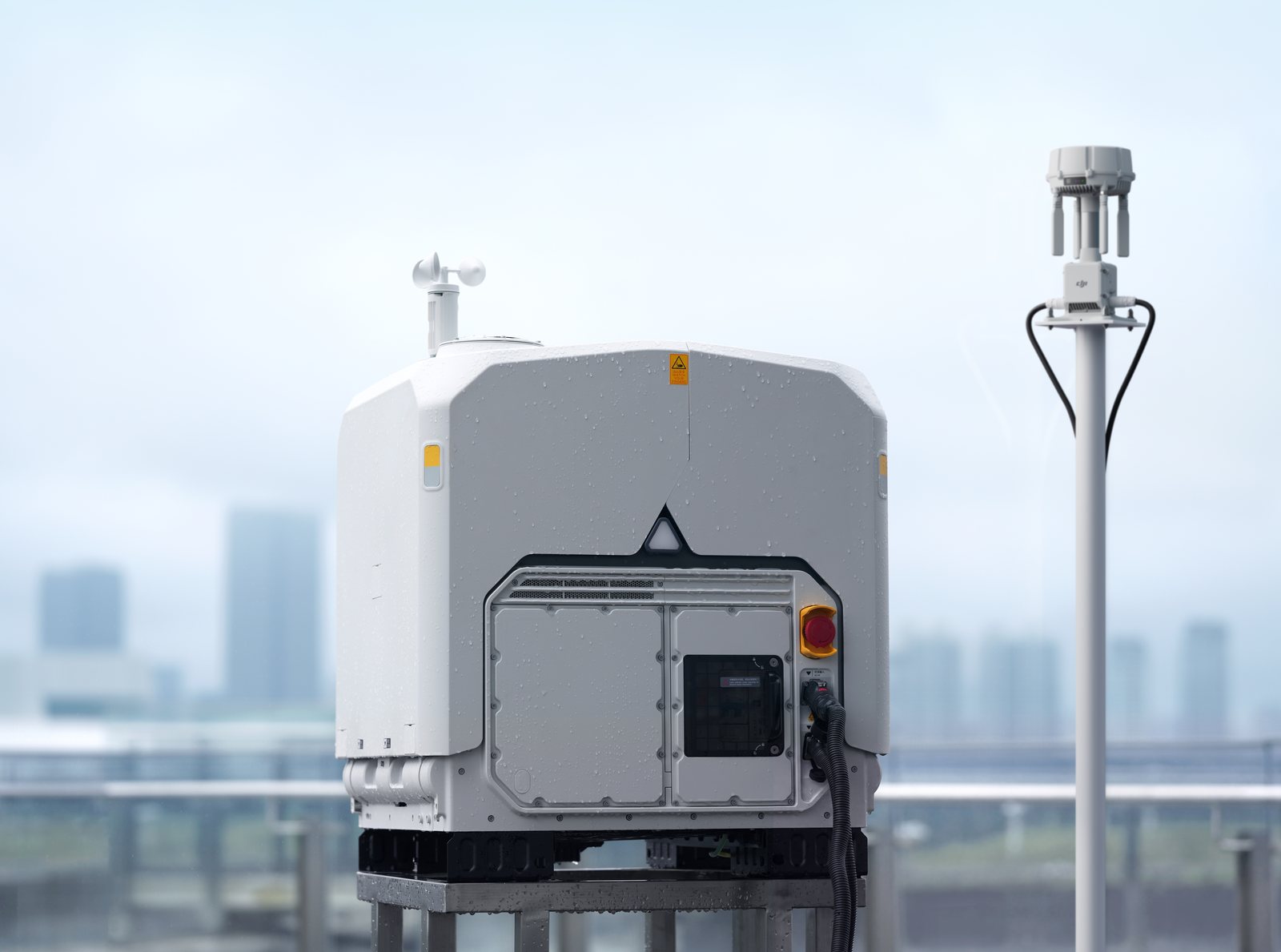
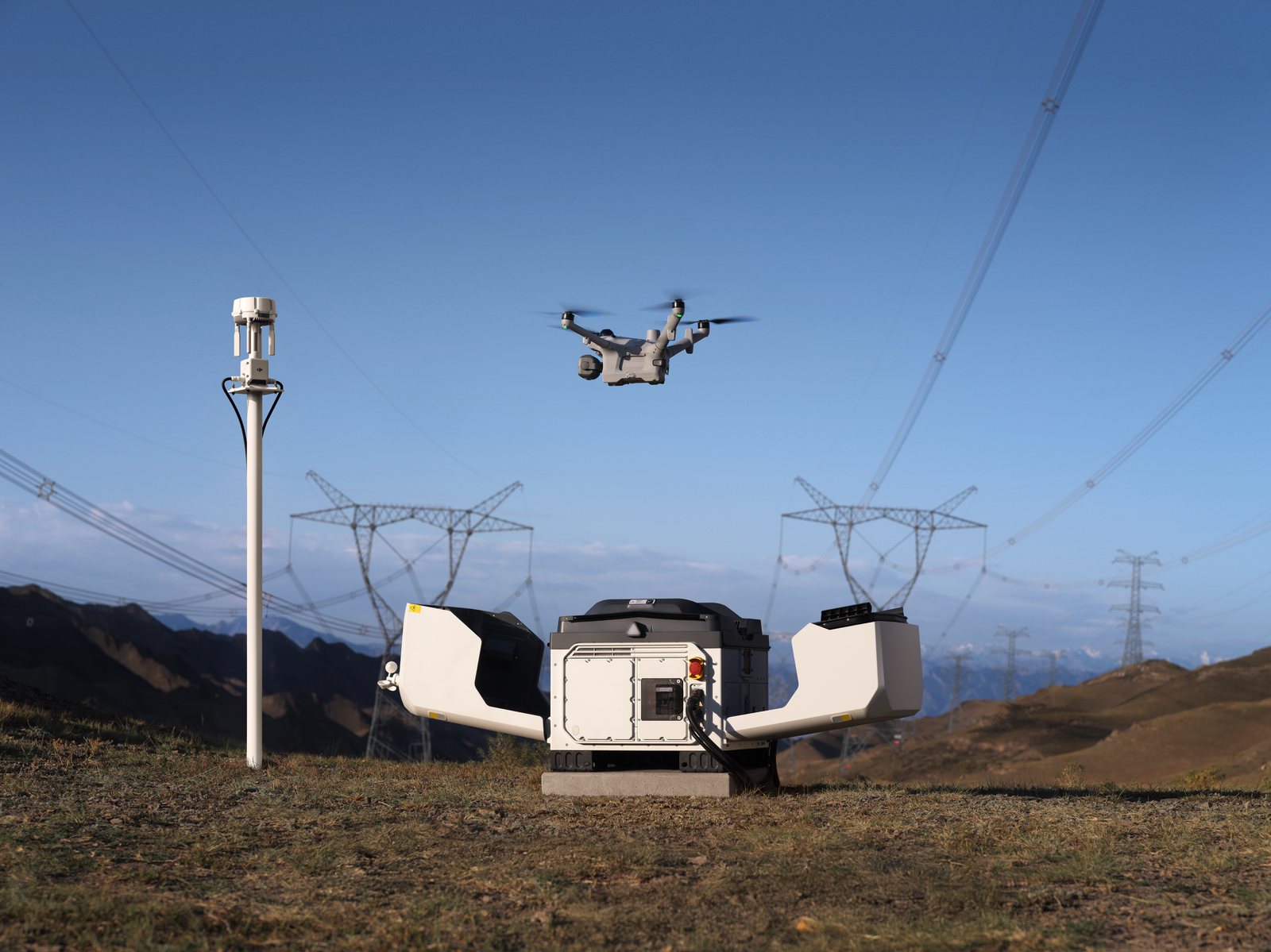
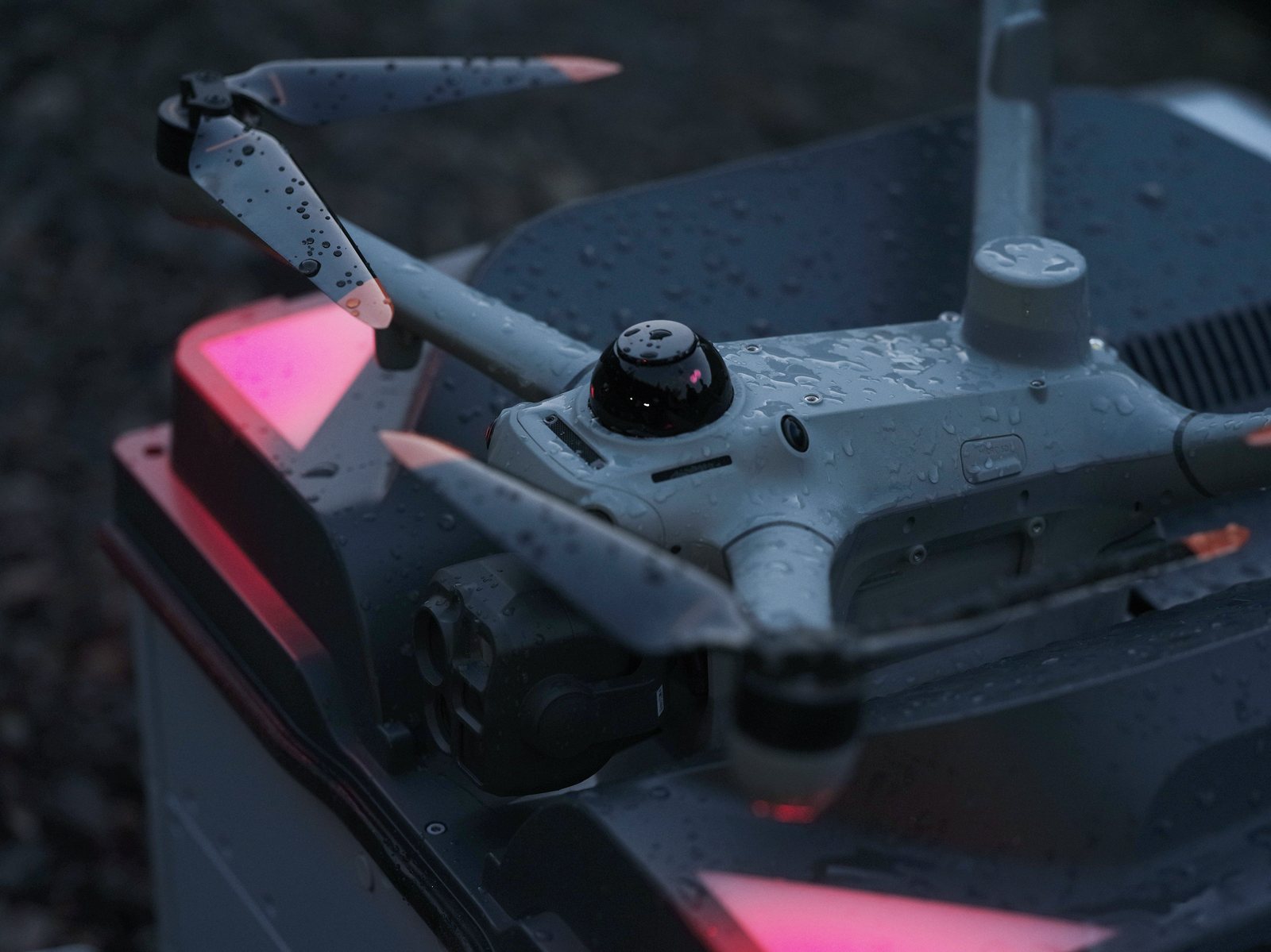
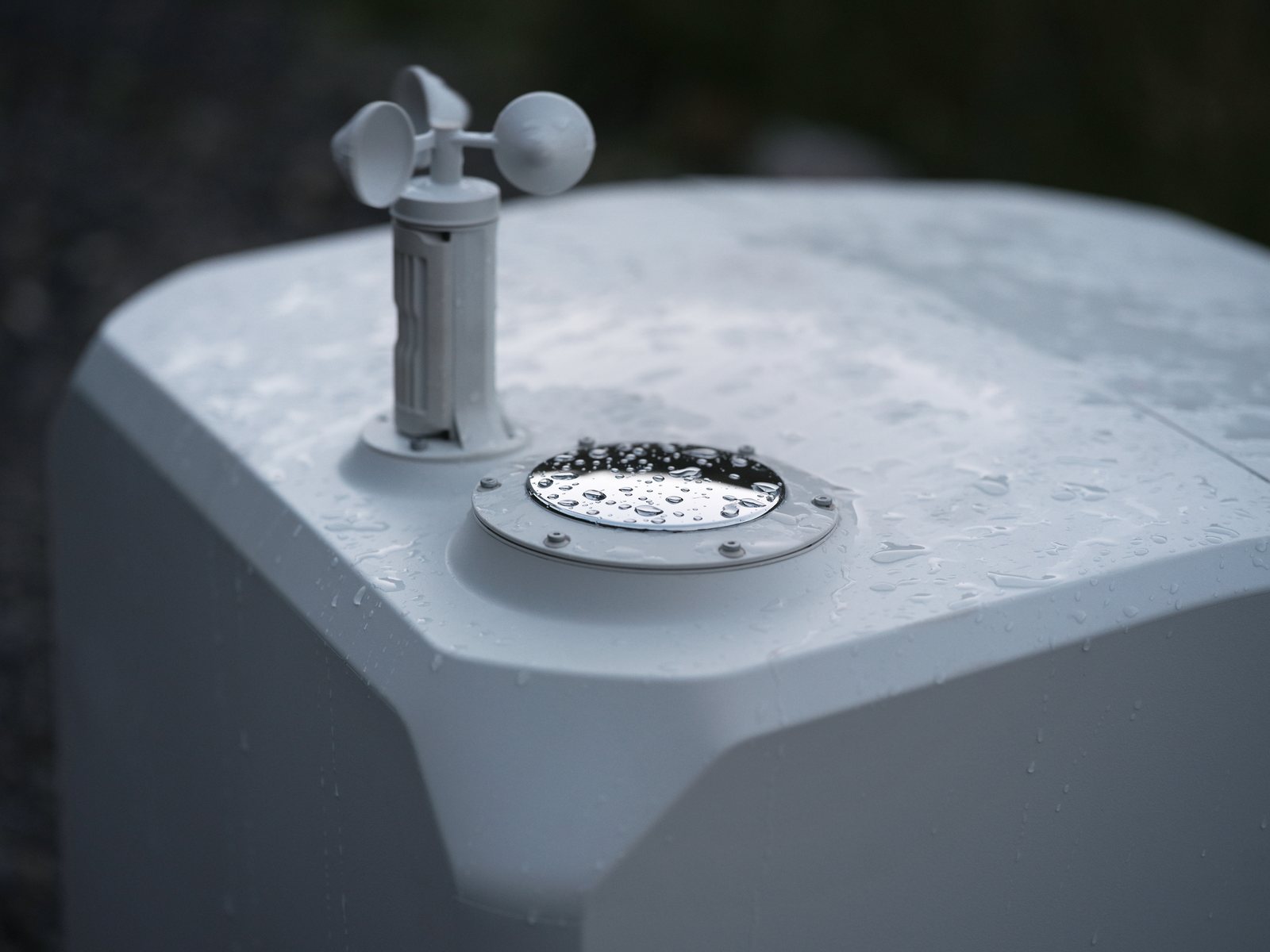
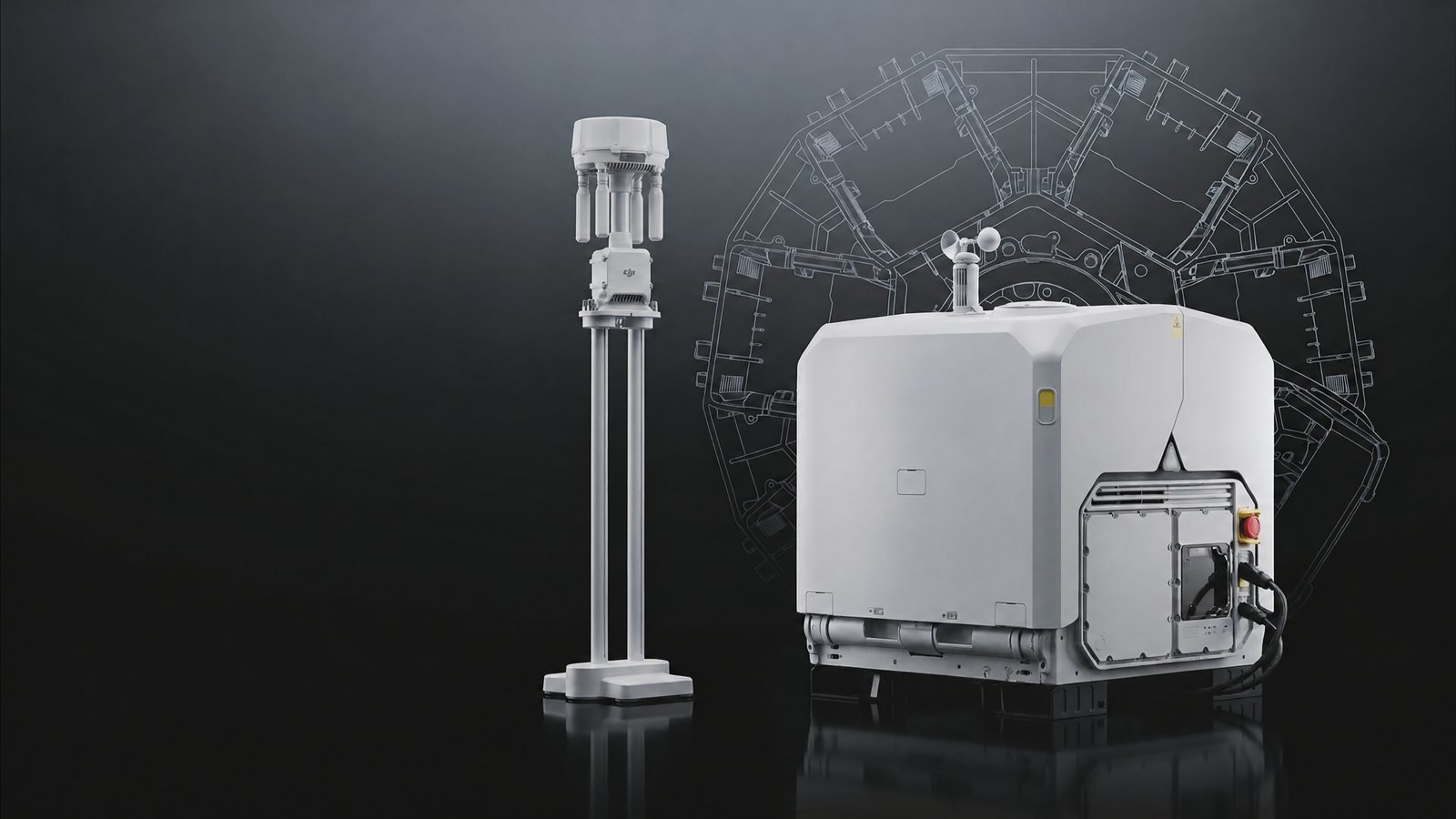
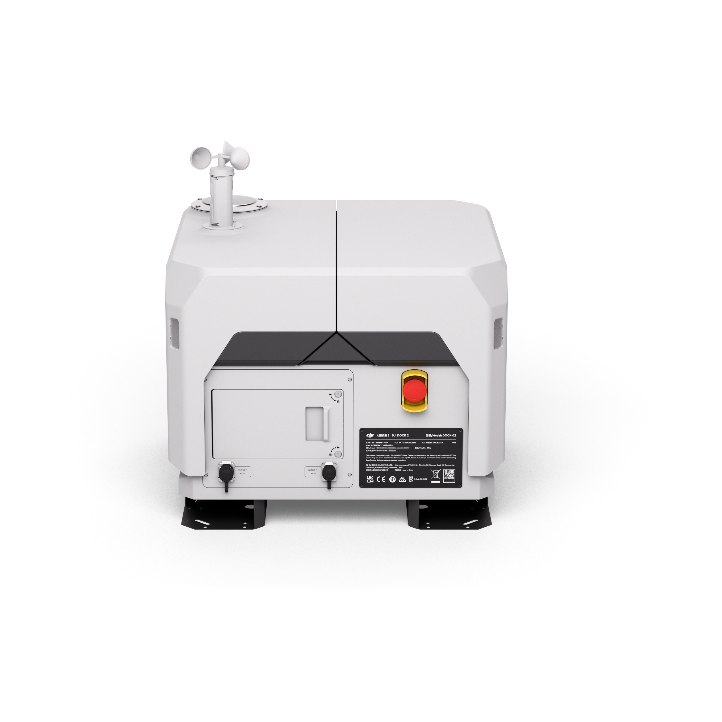
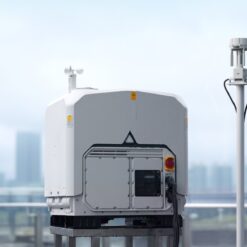
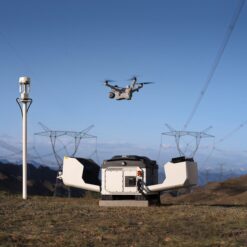
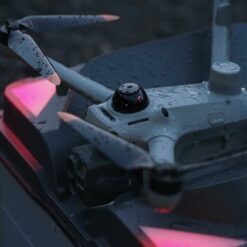

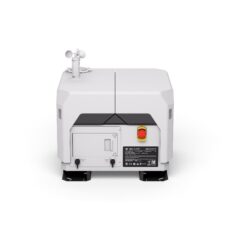
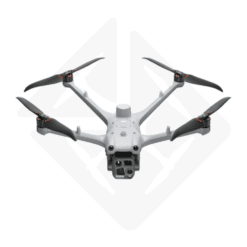
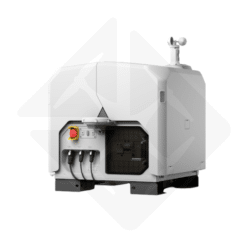
DJI Dock 4 – Autonomous Battery-Swapping Station for the DJI Matrice 5TD

- Fourth-generation drone-in-a-box station for the DJI Matrice 5TD
- Automatic battery swapping, with up to three spare batteries stored in the dock
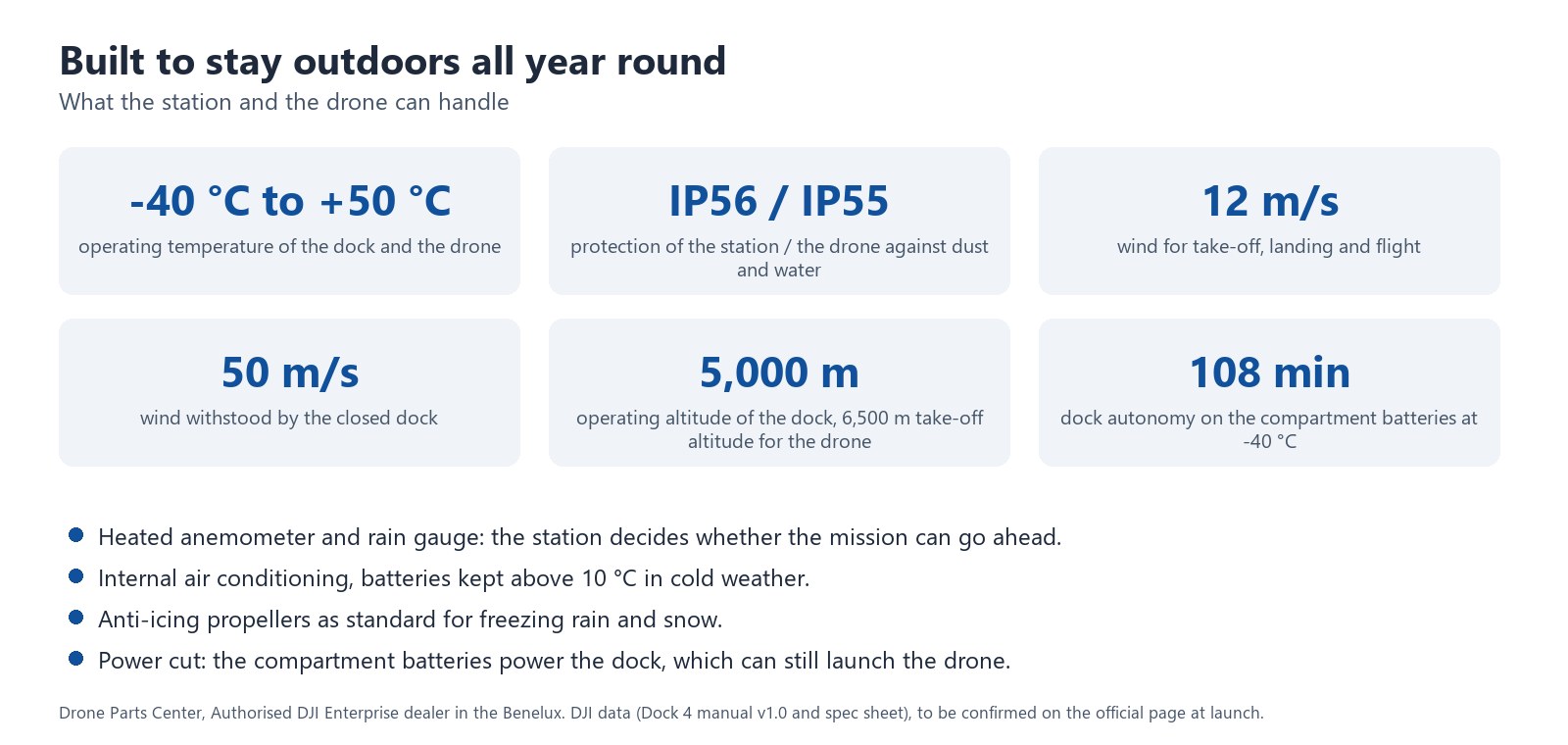
- IP56 station, -40 °C to +50 °C, remote control from DJI FlightHub 2
- Class C6 in Europe for the Matrice 5TD when used with the Dock 4
- Sold without a drone. Site survey, installation and training by Drone Parts Center
At a glance
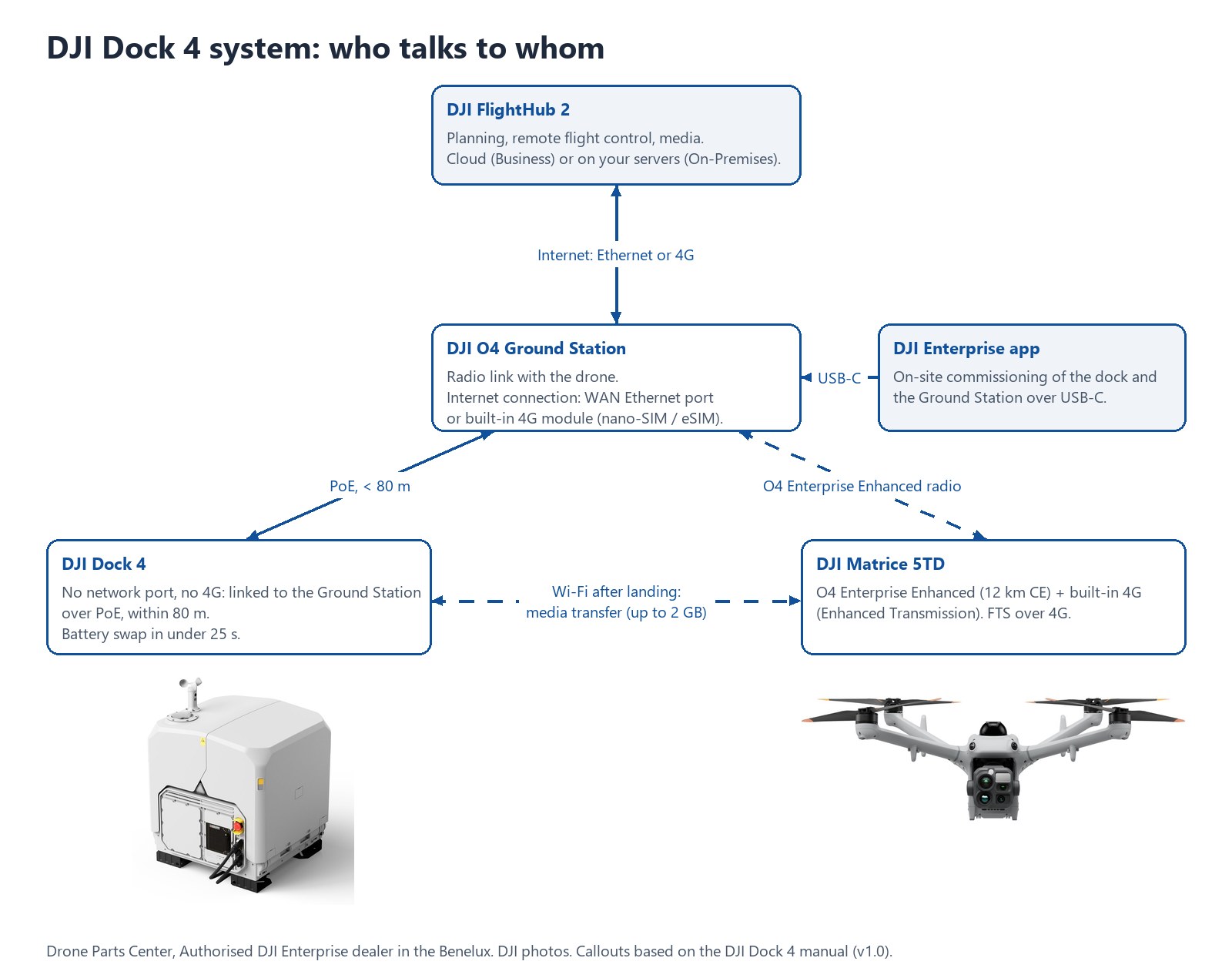
The DJI Dock 4 is DJI’s fourth-generation automated docking station, a drone-in-a-box solution. Paired with the DJI Matrice 5TD drone and the DJI O4 Ground Station, the system takes off, flies the mission, returns, lands and swaps the drone’s battery with no pilot on site, all operated remotely from DJI FlightHub 2. In Europe, the Matrice 5TD falls under class C6 when used with the Dock 4.
25 s
maximum for the battery swap, under 45 s to fly again
IP56
dust-protected station, resistant to water jets
12 m/s
wind for take-off and landing
-40 °C
to +50 °C in operation
C6
EU class of the Matrice 5TD with the Dock 4
15 km
between two docks in multi-dock missions
Drone Parts Center is an Authorised DJI Enterprise dealer in the Benelux, working with professional drones since 2017. We support Dock projects from the site survey through to training your teams.
The DJI Dock 4 is sold without a drone. It is designed for the DJI Matrice 5TD and also houses the Matrice 4D series (4D and 4TD); the complete system is also available as a DJI Dock 4 + Matrice 5TD bundle with four batteries.
Request a quote for the DJI Dock 4 →
What’s new with the DJI Dock 4
- Automatic battery swapping: the battery swapping module has four compartments and stores up to three batteries; when the drone returns, the dock replaces its battery with a charged one.
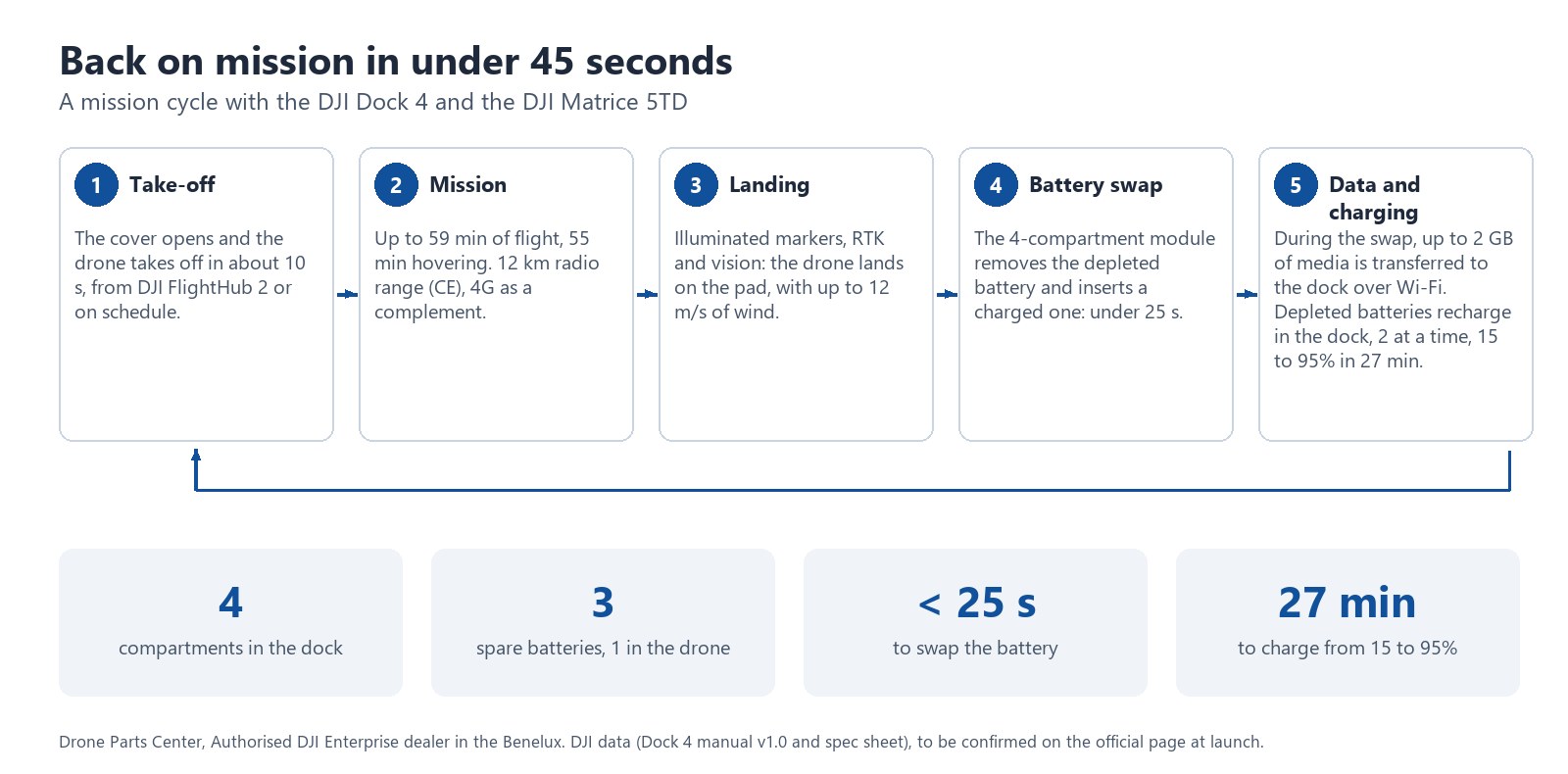
- Back on mission in under 45 s: the swap itself takes less than 25 s, from the cover closing to the charged battery being inserted; meanwhile, up to 2 GB of media is transferred to the dock over Wi-Fi.
- Take-off in about 10 s after the cover opens.
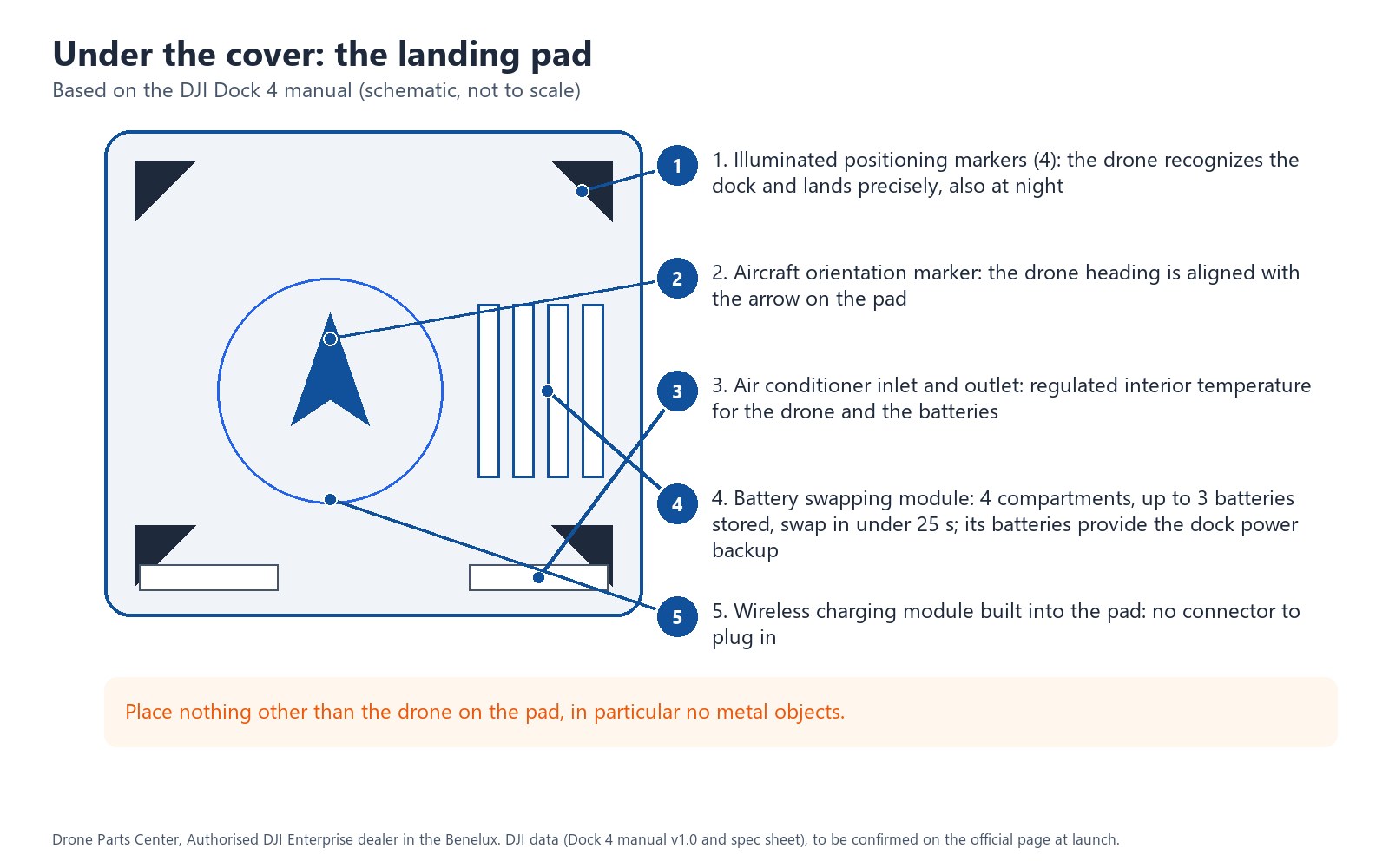
- Wireless charging as a backup: the landing pad has a built-in wireless charging module; it is a backup solution that brings a battery back to 95% in about two hours.
- IP56-rated station (IEC 60529 standard, laboratory conditions), used with the DJI Matrice 5TD drone, which is itself IP55-rated.
- Class C6 in Europe: the Matrice 5TD falls under class C6 when used with the DJI Dock 4.
- Geo caging and flight termination system (FTS): the flight is automatically terminated if the drone leaves the operation volume defined in DJI FlightHub 2.
- Proven reliability: according to DJI, the swapping mechanism has gone through 300,000 lab cycles (heat and humidity, deep freeze, sand and dust) and one million swaps on 300 docks in field tests, in extreme heat, sub-zero cold, salt fog and coastal winds.
How the Dock 4 manages batteries
Each time the drone returns, the swap arm replaces its battery in six steps:
- The drone lands and is aligned on the pad.
- The depleted battery is gripped and removed.
- The swap arm rotates.
- The depleted battery is placed in a free compartment.
- A charged battery is inserted into the drone.
- The drone is ready to take off again.
- Three charged batteries, one free bay: the sector-shaped compartment has four bays; it holds up to three charged batteries and leaves one bay empty for the drone’s depleted battery.
- Always at 95%: the Dock 4 runs in “Standby” mode only, and all batteries are kept at 95% for immediate departure.
- When a swap happens: on landing, before an operation or one hour before a scheduled automated mission, and only if the best battery is above 90% and more than 10 points ahead of the drone’s battery.
- Charging: two batteries charge at the same time, from 15 to 95% in 27 min (at 25 °C).
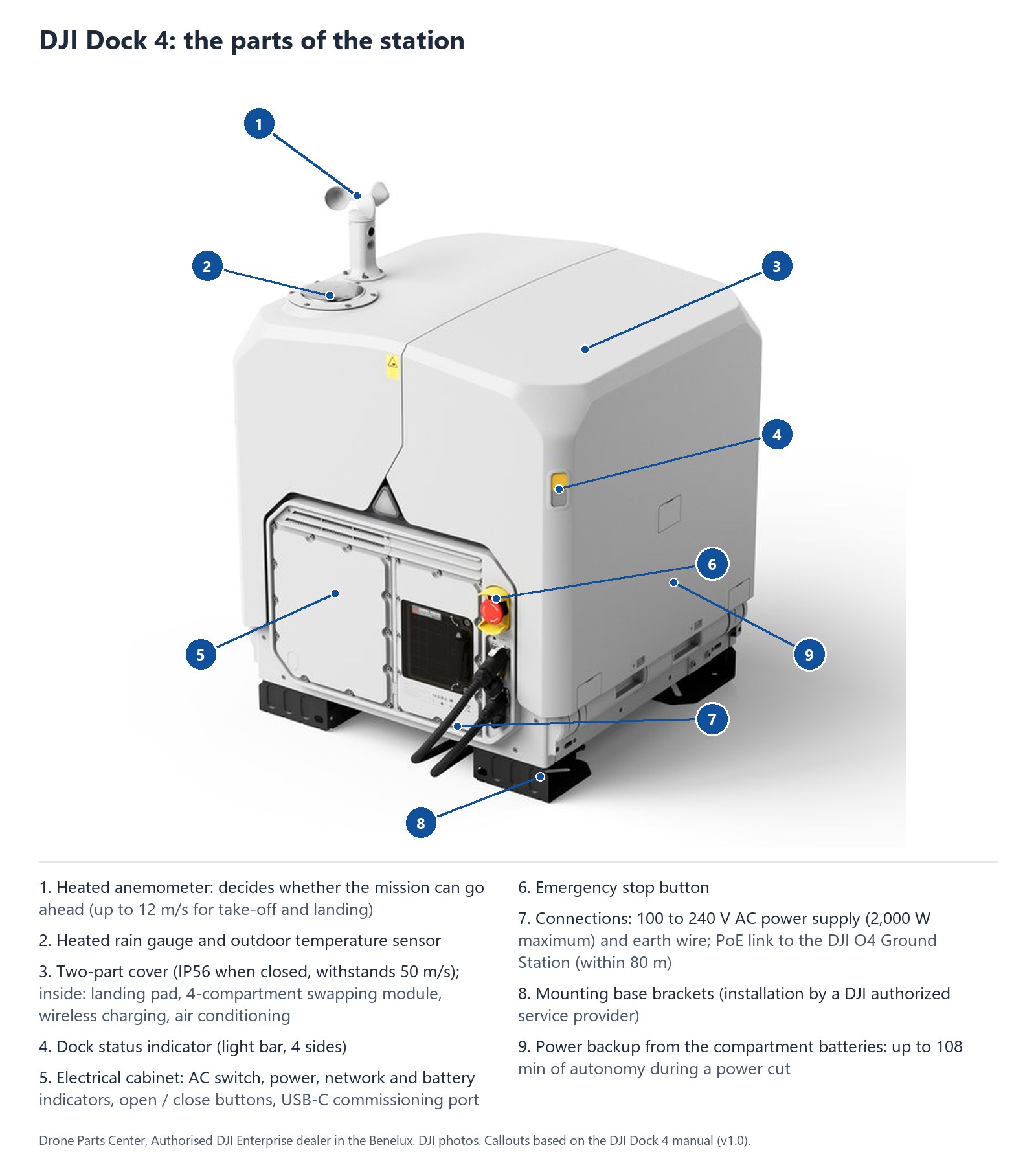
- No dedicated backup battery: if mains power fails, the batteries in the compartment power the dock; it can still swap the battery and launch the drone.
A station that decides whether the mission can go ahead
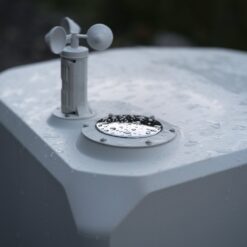
- Heated anemometer and rain gauge that also work in low temperatures.
- Outdoor temperature sensor and site camera with auxiliary lighting.
- Remotely adjustable internal air conditioning to protect the drone and batteries.
- Battery kept warm above 10 °C while the drone is idle in cold weather.
- Landing pad with illuminated positioning markers and a drone orientation marker.
Connection to the site and to DJI FlightHub 2
The Dock 4 connects to the DJI O4 Ground Station over PoE, less than 80 m away. The dock itself has no network port and no 4G module: the O4 Ground Station handles the radio link with the drone and the system’s connection to DJI FlightHub 2, through its WAN Ethernet port to the site network, or over 4G with the DJI Cellular Dongle 2 fitted on the Ground Station (sold separately). 4G is also used by the flight termination system (FTS), which requires cellular coverage over the whole flight area.
- Mission planning and a flight route library, from a web browser.
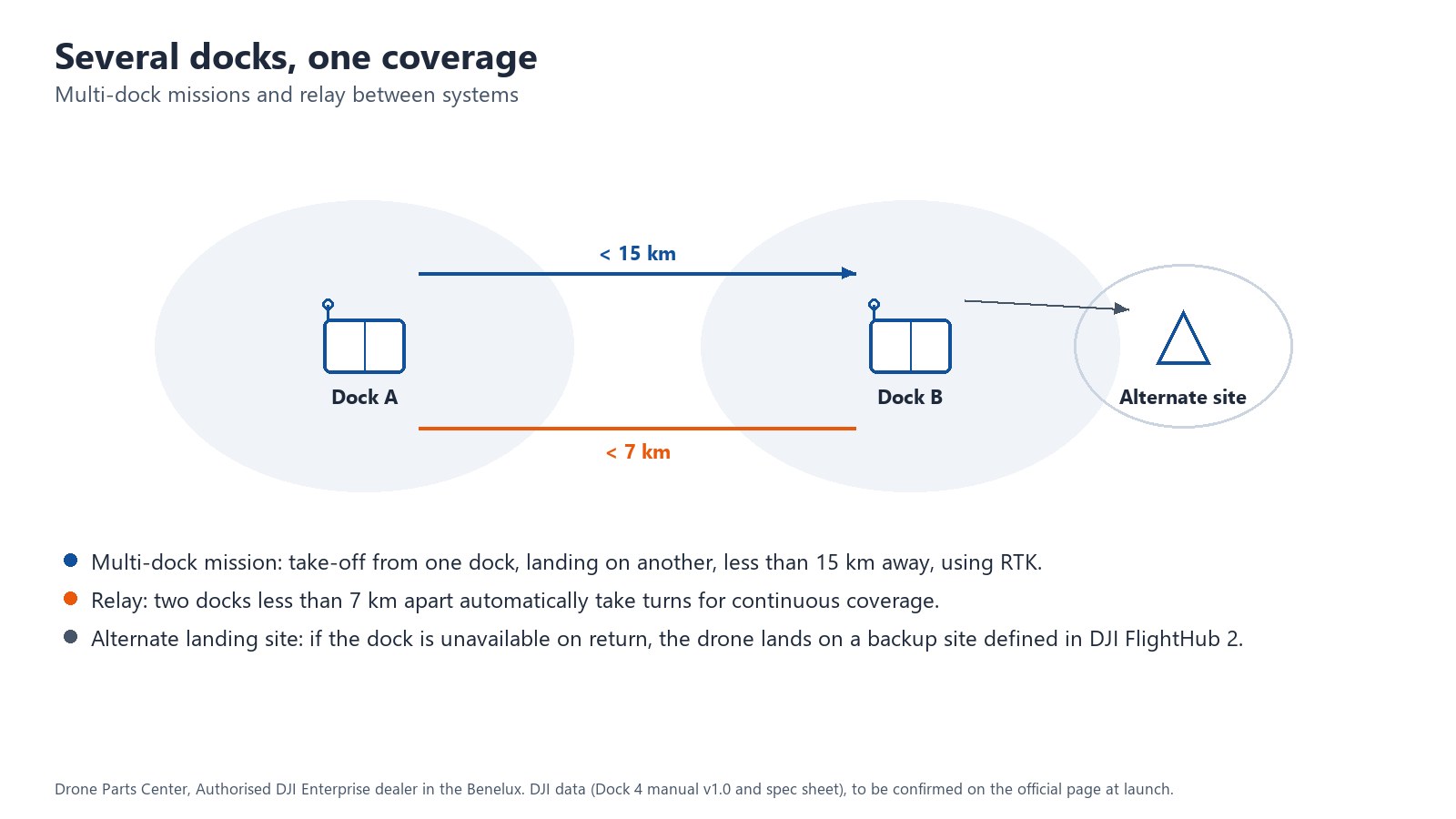
- Multi-dock missions: the drone takes off from one dock and lands on another less than 15 km away, using RTK.
- Alternate landing site if the dock is unavailable when the drone returns.
- Batteries always ready: “Standby” mode, all kept at 95%, for scheduled patrols and urgent missions alike.
- Remote lid opening and closing, and remote firmware updates for the dock and the drone.
- Relay between two systems: two docks less than 7 km apart can automatically take turns for continuous coverage.
- Extended coverage: a second DJI O4 Ground Station extends the range (internet access required); the drone connects to the nearest station, with roaming enabled before take-off.
- Live video encoded in H.265 on board and relayed to the cloud without re-encoding: about 160 ms of latency from drone to screen, according to DJI.
Licenses: DJI FlightHub 2 Business in the cloud, or DJI FlightHub 2 On-Premises on your servers. Training: getting started with FlightHub 2.
Which missions is it for?
- Site security: scheduled patrols and alarm verification, with remote take-off from DJI FlightHub 2 and video shared with the teams in the DJI Enterprise app. See our safety and rescue solutions.
- Recurring inspection: the same flight routes, repeated at regular intervals over a structure or an infrastructure asset. See building and infrastructure inspection.
- Environmental monitoring: regular surveys of a site, with the dock’s weather data (wind, rain, outdoor temperature). See environmental monitoring.
- Large areas: dock-to-dock missions, less than 15 km apart, to cover a site larger than a single operating radius.
Official accessories
DJI offers the following accessories for the DJI Dock 4 system; the first three fit on the Matrice 5TD’s accessory mount:
- DJI AS2D speaker: 120.5 dB at 1 m, 400 m range; live or recorded voice broadcasting, text-to-speech in 7 languages (DJI FlightHub 2 public cloud); IP55.
- DJI AL2D spotlight: spot and flood modules, 2.6 times brighter than the previous generation, lights up to 100 m; strobe mode, gimbal follow; IP55. With the spotlight on, visual obstacle sensing is disabled.
- DJI AP1 parachute: supplied pre-installed in the European version; works with the drone’s Flight Termination System (FTS) and is triggered from DJI FlightHub 2 or by the FTS.
- DJI Cellular Dongle 2: fitted on the DJI O4 Ground Station, it connects it to the mobile network over 4G, so the dock can be deployed and operated remotely even without Ethernet.
A second DJI O4 Ground Station extends coverage, and the drone roams from one to the other (internet connection required). Mounting details on the DJI Matrice 5TD product page. The speaker, the spotlight and the DJI Cellular Dongle 2 are quoted based on your project.
DJI Dock 4 or DJI Dock 3?
| Criterion | DJI Dock 4 | DJI Dock 3 |
|---|---|---|
| Drones | DJI Matrice 5TD, Matrice 4D series (4D and 4TD) | Matrice 4D series (4D and 4TD); Matrice 5TD with the O4 Ground Station upgrade kit announced by DJI |
| Drone battery | Automatic swap in under 25 s (up to 3 spare batteries) | Drone charged in the dock, 15 to 95% in 27 min (DJI, at 25 °C) |
| Connection | Via the DJI O4 Ground Station (PoE, within 80 m): Ethernet, or 4G with the DJI Cellular Dongle 2 fitted on the Ground Station | Ethernet on the dock, or 4G with the DJI Cellular Dongle 2 (sold separately) |
| RTK | Via the DJI O4 Ground Station | Built into the dock |
| Power backup | Batteries in the compartment | Built-in backup battery |
| Operating temperature | -40 °C to +50 °C | -30 °C to +50 °C |
| Operating altitude | 5,000 m | 4,500 m |
| Maximum power | 2,000 W | 800 W |
| Weight | 66 kg without batteries | 55 kg without drone |
| Protection | IP56 station, IP55 drone | IP56 station, IP55 drone |
| EU class of the drone with the dock | C6 | C6 |
The main differences are power and connectivity: after each mission, the Dock 4 replaces the drone’s battery with a charged one, whereas the Dock 3 recharges the drone’s own battery; the Dock 4 also connects through the DJI O4 Ground Station. Your Matrice 4D and 4TD remain usable: the Dock 4 houses them, and the DJI Dock 3 will take the Matrice 5TD with the O4 Ground Station upgrade kit announced by DJI; full range: Drone In the Box.
BVLOS flights and compliance
The Dock 4 and the Matrice 5TD are designed for beyond visual line of sight (BVLOS) operations in the specific category. DJI provides a compliance package for SAIL II: statements of compliance with the applicable means of compliance (MoC), SORA safety portfolio and operations manual templates, and compliance checklists. The package supports the authorization request; it does not replace it.
- M2 mitigation: the DJI AP1 parachute meets EASA medium robustness requirements (MoC 2512, ASTM F3322), which lowers the ground risk class.
- Independent flight termination: the FTS is segregated from the autopilot and terminates the flight even after a total loss of drone power (MoC 2511); it requires at least one 4G SIM card.
- EU type-examination certificate No. 0370-UAS-0147 (Applus+, notified body 0370): classes C5 and C6 for the Matrice 5TD, certified with the Dock 4 and the O4 Ground Station.
- Data: according to DJI, DJI FlightHub 2 has been assessed against the EU NIS2 directive and the ISO 27001 standard (access audit logs, end-to-end encryption); the On-Premises version keeps data on your servers.
Installation and commissioning
DJI requires the Dock 4 to be installed by an authorized service provider, with the drone prepared on site. Our technicians are DJI-certified on the Dock 2, Dock 3 and Dock Advanced. We handle the site survey, installation, configuration in DJI FlightHub 2 and team training, in Nivelles or at your site.
- Handling: 66 kg, two people to lift the dock; 0.41 m² footprint.
- Power: 100 to 240 V AC; plan for a supply of more than 2,200 W (maximum dock consumption: 2,000 W). The DJI Power 1000 mini is not supported.
- Network: PoE link of less than 80 m between the site router and the DJI O4 Ground Station, which also provides RTK, required for the Dock 4.
- Already own a Dock 3? Its concrete base and mounting holes can be reused; its power cables, however, are not compatible.
- Entry and exit route: during commissioning, the drone flies a square route around the dock and records its surroundings; this route then guides every take-off and return.
DJI Dock 4 key specifications
| Model | DJI Dock 4 (DOCK-04) |
| Compatible drones | DJI Matrice 5TD; DJI Matrice 4D series (4D and 4TD) |
| Ingress protection rating | IP56 (IEC 60529) |
| Battery swapping | 4 compartments, up to 3 charged batteries; swap in under 25 s, full turnaround in under 45 s |
| Charging | 2 batteries charged at the same time; 15 to 95% in 27 min (at 25 °C); wireless charging as a backup |
| Wind | 12 m/s for take-off and landing; 50 m/s with the dock closed |
| Operating temperature | -40 °C to +50 °C |
| Operating altitude | up to 5,000 m |
| Power supply | 100 to 240 V AC, 50/60 Hz, 2,000 W maximum; plan for a supply of more than 2,200 W |
| Power backup | batteries in the compartment, no dedicated backup battery; up to 108 min of dock autonomy at -40 °C |
| Sensors | Heated anemometer and rain gauge, outdoor temperature; cover and cabin cameras (1080p, 151°, with lighting) |
| Link | DJI O4 Enterprise Enhanced through the DJI O4 Ground Station (PoE, within 80 m); Ethernet, or 4G with the DJI Cellular Dongle 2 fitted on the Ground Station |
| RTK | through the DJI O4 Ground Station, required |
| Wi-Fi (media) | 80 MB/s for videos larger than 2 GB, 40 MB/s for other files |
| Drone / Ground Station radio range | 12 km (CE, unobstructed and free of interference) |
| Multi-dock missions | Docks less than 15 km apart |
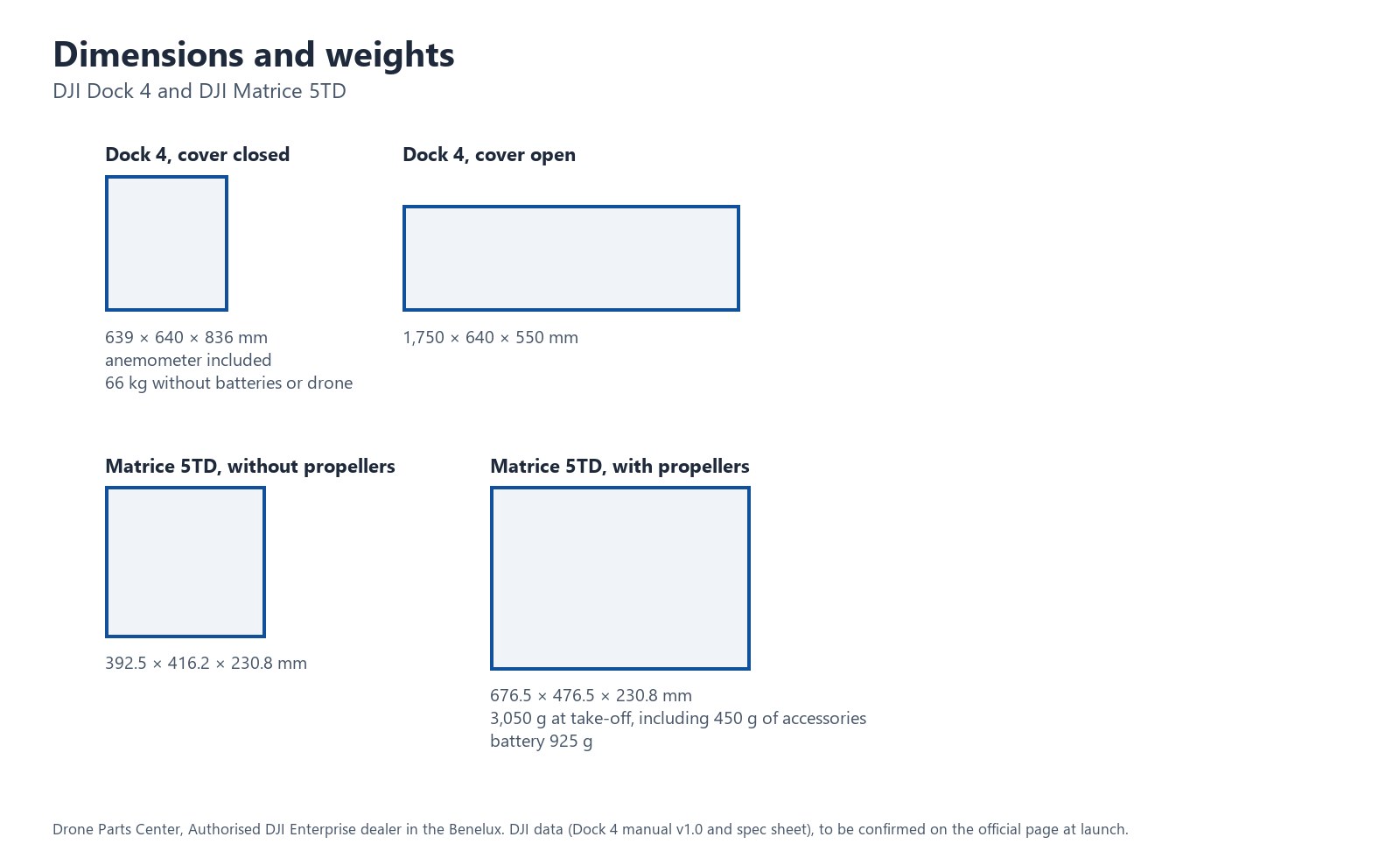
| Dimensions | Cover closed: 639 × 640 × 836 mm; open: 1,750 × 640 × 550 mm |
| Weight | 66 kg, without batteries or drone |
| Service life | 5 years; swapping mechanism designed for at least 20,000 cycles, tested over 300,000 lab cycles (DJI) |
Compatible AIRINS gas sensors
The DJI Dock 4 and the DJI Matrice 5TD are compatible with two AIRINS sensors for gas detection on automated missions: the Sniffer4D Nano 2 Plus (multi-gas or methane) and the MetScan Nano 1D (remote methane detection, TDLAS laser). Details are given in our AIRINS and DJI compatibility table.
Frequently asked questions
What is the difference between the DJI Dock 4 and the DJI Dock 3?
The DJI Dock 4 houses the DJI Matrice 5TD and swaps the drone’s battery by itself in under 25 s, using a four-compartment module that keeps up to three charged batteries; the DJI Dock 3 recharges the Matrice 4D or 4TD battery inside the dock, from 15 to 95% in 27 min. The Dock 4 operates from -40 °C to +50 °C (-30 °C for the Dock 3), up to 5,000 m altitude, and connects through the DJI O4 Ground Station, which also provides RTK. The two stations are cross-compatible: the Dock 4 also houses the Matrice 4D series, and the Dock 3 will take the Matrice 5TD with the O4 Ground Station upgrade kit announced by DJI.
How much does the DJI Dock 4 cost?
The price depends on the configuration: station only or bundle with the DJI Matrice 5TD and four batteries, DJI FlightHub 2 license, on-site installation and commissioning. Drone Parts Center provides a quote based on your project.
Is the DJI Dock 4 sold with the drone?
No, the station is sold on its own. It works with the DJI Matrice 5TD, available separately or in the DJI Dock 4 + Matrice 5TD bundle with four batteries.
What network connection does the site need?
The system connects to DJI FlightHub 2 through the DJI O4 Ground Station: a wired internet connection on its WAN port, or 4G with the DJI Cellular Dongle 2 fitted on the Ground Station. On a fixed site, a wired connection is the reference solution; 4G suits sites without a network or serves as a backup, keeping in mind the data volume (about 1 GB per 30-minute flight when transmission switches to 4G) and coverage, which the FTS module requires anyway. Drone Parts Center’s site survey covers the network, 4G coverage and the power supply.
How many batteries should I plan for with the DJI Dock 4?
DJI recommends four batteries per system to fill every slot, and at least three for continuous operations with battery rotation.
Who can install a DJI Dock 4?
DJI requires installation by an authorized service provider. Drone Parts Center, an authorised DJI Enterprise dealer in the Benelux, handles the site survey, installation, configuration in DJI FlightHub 2 and team training.
Do you need a qualified remote pilot to operate a DJI Dock 4?
Yes. A drone-in-a-box is still a drone operation, under the responsibility of a registered operator and a qualified remote pilot. The Matrice 5TD’s class C6 with the Dock 4 is a condition for the standard scenarios, not an authorization: access also depends on the operator declaration, the remote pilot’s competency and the operations manual.
Can a DJI Dock 3 installation be reused for a DJI Dock 4?
Partly. The Dock 3 concrete base and mounting holes can be reused. Its power cables are not compatible, and the power supply must exceed 2,200 W, compared with a maximum consumption of 800 W for the Dock 3. The site survey by Drone Parts Center checks these points.
What happens during a power outage?
The Dock 4 has no dedicated backup battery: the flight batteries stored in its compartment power it. It can still swap the battery and launch the drone, and a drone in flight can return and land.
Drone Parts Center – DJI Enterprise Authorized Reseller, Nivelles, Belgium
Vous pourriez préférer


Related products
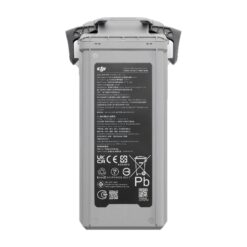
Available to order: contact us for lead time.
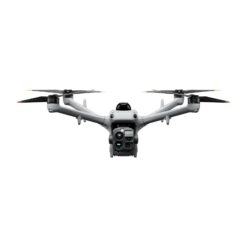
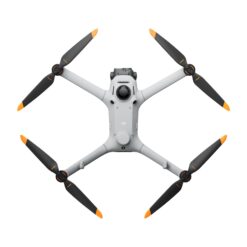
Available to order: contact us for lead time.

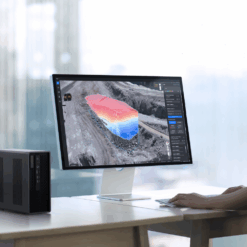
Drone In the box
DJI FlightHub 2 AIO Combo – FlightHub 2 On-Premises all-in-one server, ready in 10 minutes
Available to order: contact us for lead time.

Drone In the box
DJI Dock 3 – The stand-alone docking station for professional drones
In stock