

Regulation & Certification
DJI Matrice 4D and 4TD: C6 compliance now available in standalone mode
Jun
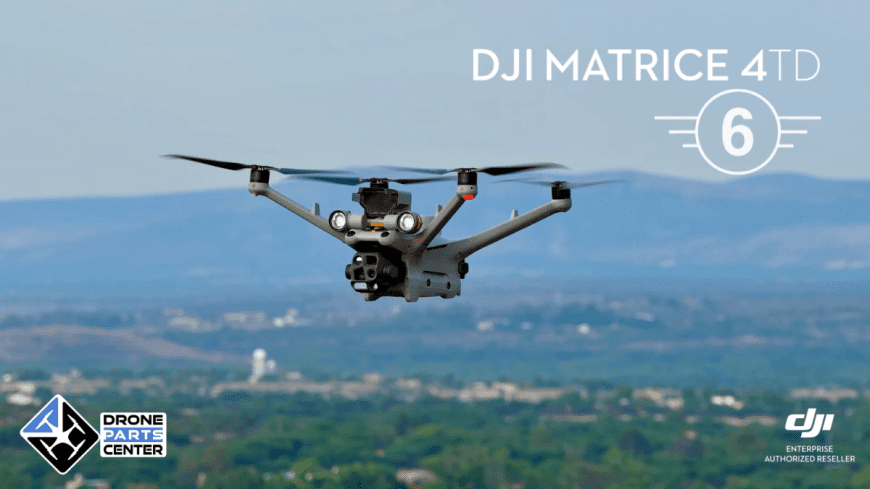
Until now, C6 compliance for the Matrice 4D applied only to automated operations from the dock. The update announced by DJI on 12 June 2026 is clear: compliance now extends to standalone mode, meaning flights piloted directly with the remote controller, without a Dock 3. For professional operators, this opens the door to beyond visual line of sight (BVLOS) operations well beyond fixed-dock use cases.
When the mission profile calls for a fixed base instead, the DJI Dock 3 docking station runs the same aircraft on automated schedules, with no pilot on site.
The essentials (update of 12 June 2026)
- DJI extends class C6 compliance of the Matrice 4D (M4D) and Matrice 4TD to manual piloting with the remote controller, not just to automated operations via the Dock 3.
- Two conditions: firmware 17.1.5 or higher and the DJI RC Plus 2 Enterprise remote controller.
- This compliance unlocks access to the STS-02 standard scenario: BVLOS flight in sparsely populated areas.
- The certification covers the aircraft only. Operator-side obligations (declaration, certificates, manuals) remain your responsibility.
What C6 compliance means (and why standalone mode changes everything)
Class C6 is an unmanned aircraft classification defined by Delegated Regulation (EU) 2019/945. It was designed for the standard scenarios of the Specific category, in particular STS-02, provided the operator also meets the requirements of Regulation (EU) 2019/947.
In practical terms, a drone marked C6 meets the hardware-side requirements of STS-02. As long as this compliance applied only to the Dock 3, your BVLOS flights were confined to automated missions from a station. By extending it to manual piloting, DJI now makes it possible to use STS-02 with a ground operator and a remote controller, without any dock infrastructure. That was the bottleneck that has now been removed.
To understand how the Dock 3 fits into this ecosystem, see our complete guide to the DJI Dock 3.
The technical requirements of class C6
To carry the C6 marking, an aircraft must meet all of the following criteria:
| Requirement | Specification |
|---|---|
| Maximum take-off mass (MTOM) | Less than 25 kg, payload included |
| Maximum characteristic dimension | 3 metres maximum |
| Maximum horizontal speed | 50 m/s maximum |
| Flight Termination System (FTS) | System independent of the flight controller, automatically activated in the event of a permanent loss of the C2 link |
| C2 link monitoring | Continuous display of 4 signal levels to the pilot (strong, medium, weak, lost) |
| Flight volume | Support for pre-programmed operational limits before the mission |
| Geocaging | Onboard system actively preventing the aircraft from leaving the defined flight geography |
The requirement for an independent FTS and C2 link monitoring directly addresses signal-loss scenarios, a risk we cover in detail in our analysis of flyaway probability for professional drones. Geocaging, for its part, relies on manufacturer geographic zones, whose evolution on DJI’s side we track closely.
STS-01 vs STS-02: the operational leap
STS-02 is not a simple variant of STS-01. It is what justifies aiming for class C6 rather than C5.
| Criterion | STS-01 | STS-02 |
|---|---|---|
| Required aircraft class | C5 | C6 |
| Environment | Controlled zone, urban area | Sparsely populated area |
| Visual line of sight on the aircraft | Continuous VLOS mandatory | BVLOS permitted during the mission |
| Horizontal speed | Limited to 5 m/s | Up to 50 m/s (C6 limit) |
| Flight path | Defined ground zones | Pre-programmed flight path |
In plain terms, STS-01 keeps you within direct visual line of sight, at reduced speed, within predefined ground zones. STS-02 allows beyond-visual-line-of-sight flight on a pre-programmed flight path, with VLOS required only during take-off and landing.
What STS-02 permits in practice
| Parameter | Limit |
|---|---|
| Maximum altitude | 120 m AGL (up to +15 m near an obstacle taller than 105 m, with authorisation) |
| Maximum distance without observer | 1 km from the remote pilot |
| Maximum distance with observer | 2 km (observer positioned at 1 km maximum) |
| BVLOS | Permitted in flight on a pre-programmed flight path |
| VLOS | Mandatory only during take-off and landing |
| Dangerous goods | Not permitted |
| Aircraft class | C6 mandatory |
The use cases unlocked by standalone mode
Linear infrastructure inspection
Power lines, pipelines, railways, roads: these infrastructures often extend well beyond the pilot’s line of sight. STS-02 in standalone mode makes their BVLOS inspection accessible without deploying a Dock 3. To assess the return on investment and the associated certifications, see our report Drone inspection in 2026: equipment, certifications and ROI.
A specific case is gas pipelines: drone-based leak detection gains directly from BVLOS range. The Matrice 4D can carry TDLAS payloads such as the MetScan Nano 1 methane detector, a topic we cross-reference with the regulatory framework in Drone methane detection: what the European Regulation changes.
Search and rescue
Search missions over large areas of open terrain fall within the BVLOS scope of STS-02: the aircraft progresses without the pilot needing to reposition. For emergency services, this gain combines with the thermal configurations of the Matrice 4TD, available in the Fire and Rescue Pack and the Police Intervention Pack.
What remains your responsibility (operator side)
An essential point not to be confused: the C6 marking satisfies hardware requirements, not operator requirements. Before an STS-02 flight, it is up to you to gather:
- the STS-02 declaration or an operational authorisation from your national competent authority (in Belgium, the DGTA);
- the theoretical knowledge certificate covering the standard scenarios;
- the STS-02 practical skills certificate specific to this scenario;
- an operations manual compliant with STS-02;
- a maintenance manual and a logbook for the M4D;
- an emergency response plan (ERP);
- an observer coordination plan for operations beyond 1 km.
This risk-mitigation logic ties in with the SORA approach, which we detail in DJI FlightHub 2 and SafeSky: expanding your operations and securing your SORA. Note also that remote identification remains a requirement: see Remote identification rules for drones in Europe.
How to activate C6 compliance on your Matrice 4D or 4TD
Two prerequisites, and only one to check on existing equipment:
- Firmware 17.1.5 or higher on the aircraft.
- DJI RC Plus 2 Enterprise remote controller, essential for standalone piloting.
This is why the configurations relevant for dock-free C6 flight are the combos that already include this remote controller: the DJI Matrice 4D Standalone Combo (with RC and charger) and the DJI Matrice 4TD Standalone Combo (with RC and charger). The Matrice 4D drone-only version remains relevant for expanding a fleet already equipped with remote controllers.
On the mission equipment side, consider power continuity with the Matrice 4 Series 200W charging hub and, for cold-weather operations, the M4D low-noise anti-icing propellers. To strengthen your risk-mitigation case in sensitive areas, the Dronavia Kronos M4D parachute provides an additional safety barrier (distinct from the regulatory FTS built into class C6).
Matrice 4D or Matrice 4TD: which one to choose?
Both aircraft are C6-eligible. The choice comes down to payload: the Matrice 4D favours precision and mapping, while the Matrice 4TD adds the thermal dimension expected in public safety and emergency response. To place this range within DJI’s current product philosophy, read DJI Matrice 4: intelligent flight with Manifold 3 and LiDAR.
If your operations are thermal and start from the dock, the DJI Matrice 4TD thermal drone is the configuration to look at: IP55 rating, full sensor suite including thermal, and native compatibility with the DJI Dock 3.
FAQ
Is the Matrice 4D C6-compliant?
Yes. Since the update of 12 June 2026, the Matrice 4D and the Matrice 4TD are compliant with class C6 in standalone mode (remote controller), provided firmware 17.1.5 or higher and the DJI RC Plus 2 Enterprise are used. Compliance already applied to operations via the Dock 3.
What does class C6 allow?
Class C6, defined by Regulation (EU) 2019/945, gives access to the STS-02 standard scenario: BVLOS flight in sparsely populated areas, on a pre-programmed flight path, provided the operator meets the requirements of Regulation (EU) 2019/947.
What is the difference between STS-01 and STS-02?
STS-01 (C5 drones) requires continuous direct line of sight at reduced speed in a controlled area. STS-02 (C6 drones) permits beyond-visual-line-of-sight flight in a sparsely populated area, with direct line of sight required only at take-off and landing.
Is the C6 marking enough to fly under STS-02?
No. C6 covers only the aircraft. The operator must additionally file an STS-02 declaration, hold the theoretical and practical certificates, and keep the manuals and plans required by their national competent authority.
Is a Dock 3 required for C6 compliance?
No, not since this update. Manual piloting with the remote controller is now covered, enabling BVLOS missions without a docking station.
Conclusion
Extending C6 compliance to standalone mode is more than a firmware update: it opens up STS-02 to operators equipped with a Matrice 4D or 4TD and a remote controller, without depending on a Dock 3. Linear inspection and search and rescue missions in BVLOS become realistic for a standalone fleet. What remains is to complete the operator-side requirements, which stay your responsibility.
Always check the current requirements with your national competent authority before any STS-02 operation. References: Delegated Regulation (EU) 2019/945, Regulation (EU) 2019/947 and the EASA standard scenarios framework.