
 Français
 Nederlands
 Deutsch
Comparisons & Buying Guides, News
DJI Mavic 4 Pro vs Air 3S vs Mini 4 Pro: Which One Should You Choose?
May
Introduction: Navigating the world of DJI drones – which one is right for you?
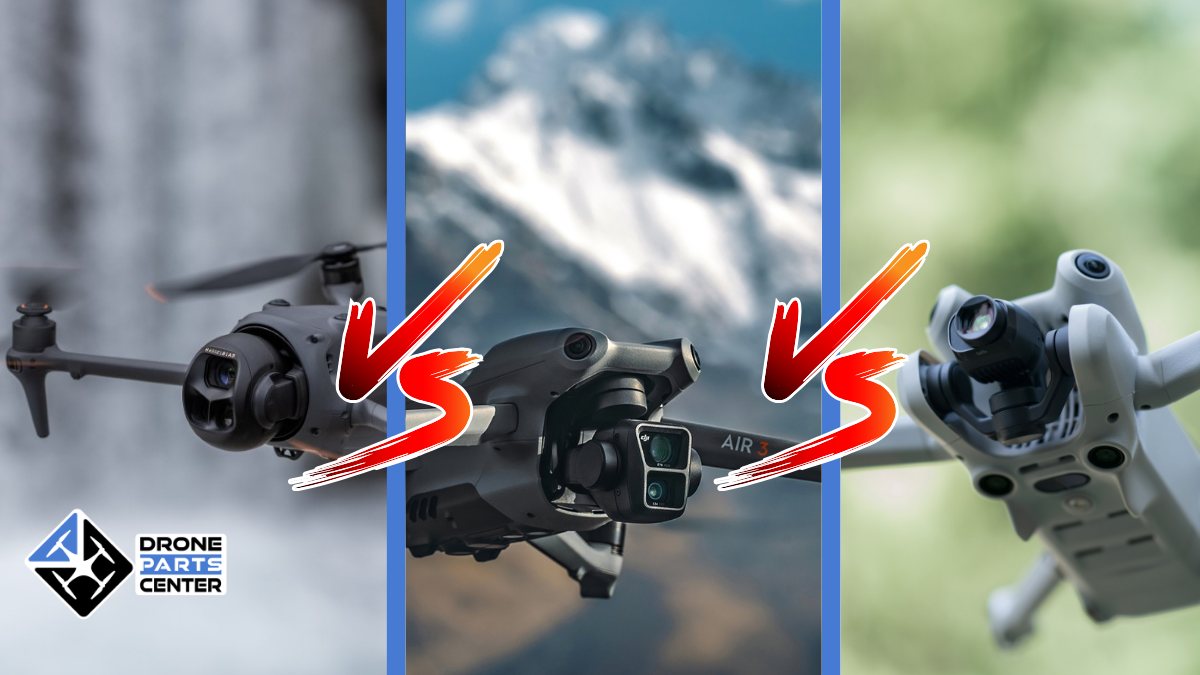
The world of DJI drones is vast and constantly evolving, offering aerial shooting solutions for all types of users, from the image professional to the travel enthusiast to the curious beginner. In 2025, three models stand out in particular, each with its own specificities and advantages: the powerful DJI Mavic 4 Pro, the versatile DJI Air 3S, and the ultra-portable DJI Mini 4 Pro. Faced with this tempting offer, a crucial question arises: which DJI drone is really right for you?
Choosing the right drone is not just about opting for the most expensive or newest model. It’s about understanding your own needs, your creative ambitions, your budget, and the regulatory constraints of your flight environment. Do you want to capture cinematic images worthy of Hollywood? Do you need a lightweight and discreet travel companion? Or are you just looking for a reliable and secure way to experience the world from a new perspective?
This comparison article aims to enlighten you. We’re going to dive deep into the specs, performance, strengths, and limitations of each of these three exceptional devices. We will analyze their camera systems, battery life, range, smart features, and portability in detail. At the end of this reading, you will have all the keys to make an informed choice and invest in the DJI drone that will perfectly meet your expectations and allow you to give a new dimension to your creations. Get ready to take off to a wise decision!
DJI Mavic 4 Pro: Ultimate Cinematic Power
The DJI Mavic 4 Pro is the flagship of DJI’s consumer lineup, a true workhorse designed for professionals and content creators who don’t compromise on image quality and performance. If your ambition is to produce stunning aerial footage, with unparalleled richness of detail and post-production flexibility, the Mavic 4 Pro is hands down the drone to consider.
Key Features of DJI Mavic 4 Pro
The Mavic 4 Pro pushes the boundaries of aerial shooting with its revolutionary tri-camera system, at the heart of which sits a 100-megapixel Hasselblad CMOS 4/3 main sensor. This setup not only captures photos with stunning resolution, but also records video up to 6K at 60 frames per second. The adjustable aperture from f/2.0 to f/11 on the main camera provides precise control of depth of field and exceptional low-light performance, while the Hasselblad Natural Color Solution (HNCS) ensures colors with breathtaking realism and fidelity. The two complementary telephoto lenses, a 70mm medium (48MP, 1/1.3-inch sensor) and a 168mm long (50MP, 1/1.5-inch sensor), open up a huge field of creative possibilities, allowing you to play with perspectives and capture distant subjects with impressive clarity.
In terms of flight performance, the Mavic 4 Pro is no slouch. It has a record-breaking battery life of up to 51 minutes, giving you plenty of time to fine-tune your plans. Its OcuSync O4+ transmission system ensures a stable video link and a theoretical range of up to 30 km in HDR transmission and 41 km in global range, reducing the risk of disconnection even in complex environments. Safety is also a priority with omnidirectional obstacle detection provided by six fisheye sensors and the advanced ActiveTrack 360° system for intelligent and reliable subject tracking. A major innovation is its Infinity Gimbal gimbal, capable of 360° rotation and upward tilt, increasing the possible shooting angles tenfold.
Who is the DJI Mavic 4 Pro for?
The DJI Mavic 4 Pro is clearly aimed at image professionals, filmmakers, advertising photographers and highly demanding content creators. Its price, although not officially communicated for all regions at the time of our analysis (around €2099 for the drone alone in Europe), positions it in the high-end segment. If your core business is to produce the highest quality aerial images, if you need maximum flexibility in terms of focal lengths and creative control, and if budget is not your main constraint, then the Mavic 4 Pro is an investment that will meet your highest expectations. It is also an excellent choice for high-precision technical inspections thanks to the resolution of its sensors.
Strengths and weaknesses of the Mavic 4 Pro
- Highlights: Outstanding 100MP Hasselblad image quality, versatile tri-camera system, 6K/60p video, 51-minute battery life, 360° Infinity Gimbal, rugged O4+ transmission, advanced omnidirectional obstacle detection.
- Weaknesses: Very high price, potentially heavier and bulky (exact weight to be confirmed), not available in the US at launch.
The Mavic 4 Pro is a technological showdown, offering capabilities that were until recently reserved for much more expensive and complex equipment.
DJI Air 3S: The Perfect Balance of Performance and Versatility
The DJI Air 3S is positioned as an extremely attractive choice for content creators who are looking for a capable, versatile drone, without reaching the level of investment (and sometimes complexity) of the Mavic 4 Pro. It embodies a remarkable balance between image quality, advanced features and a still very appreciable portability.
Key Features of DJI Air 3S
At the heart of the DJI Air 3S is a high-performance dual main camera system . The wide-angle camera has a 1-inch CMOS sensor offering 50 megapixels, while the medium telecamera has a 1/1.3-inch CMOS sensor with a 48-megapixel equivalent focal length. This combination captures images rich in detail and offers creative flexibility to vary shots, from wide landscapes to tighter portraits with a beautiful compression effect. Both cameras are capable of recording video up to 4K at 100 frames per second, and support D-Log M and HLG color profiles for greater latitude in post-production. The fixed aperture is f/2.8 for both lenses.
The Air 3S also shines with its flight performance. It offers a comfortable battery life of 45 minutes, allowing for extended flight sessions. The O4 video transmission system ensures a reliable connection up to 20 km (FCC standard) and video feedback in 1080p/60fps. Safety is not to be outdone with omnidirectional obstacle detection, making flying more serene, even in environments with obstacles. With a weight of 724 grams, it remains relatively easy to carry, although it does not fall into the category of drones under 250g. Its 42 GB internal storage is a welcome plus for starting without an external memory card, although the latter will remain essential for large shoots.
Who is the DJI Air 3S for?
The DJI Air 3S is the ideal drone for advanced content creators, semi-professionals, and demanding enthusiasts who want a powerful tool without blowing their budget. It is ideal for videographers and travel photographers who need higher image quality than the Mini series, while still being easy to carry. If you’re looking to move upmarket after a more basic first drone, or if the capabilities of the Mini 4 Pro seem a little too small for your ambitions, the Air 3S represents an excellent step. Its dual lens offers versatility that single-camera drones can’t match, allowing for varying compositions without losing quality due to digital zoom.
Strengths and weaknesses of the DJI Air 3S
- Highlights: Excellent value for money/performance, versatile dual camera (1-inch sensor), 4K/100fps video, good 45-minute battery life, omnidirectional obstacle detection, reliable O4 transmission, 42GB internal storage.
- Weaknesses: Less flexibility and ultimate performance than the Mavic 4 Pro (two cameras instead of three, no adjustable aperture), smaller main sensor than the Mavic 4 Pro.
The DJI Air 3S is a champion of versatility, able to adapt to a multitude of shooting scenarios while providing a user experience and image quality that will satisfy the vast majority of content creators.
DJI Mini 4 Pro: Freedom and performance in a pocket-sized format
The DJI Mini 4 Pro is proof that performance doesn’t always mean bulk. This ultra-compact drone, weighing less than 249 grams (with its standard battery), is a real technological feat that will appeal to beginners as well as travelers or on-the-go content creators. It combines disconcerting ease of use, extreme portability, and imaging capabilities that are amazing for its class.
Key Features of DJI Mini 4 Pro
Despite its small size, the Mini 4 Pro has a 1/1.3-inch 48-megapixel CMOS sensor, capable of shooting in 4K at up to 100 frames per second and capturing RAW photos for maximum flexibility in post-processing. Its bright lens with an aperture of f/1.7 ensures good performance even in scarce light. One of the key features is its ability to shoot native vertical shots, ideal for social media content. It also supports 10-bit D-Log M and HLG color profiles, providing wide dynamic range and rich colors.
Where the Mini 4 Pro particularly impresses for its category is in terms of safety. It is equipped with omnidirectional obstacle detection, a feature usually reserved for larger, more expensive drones. This makes flying much safer, especially for less experienced pilots. The autonomy is also very decent, reaching 34 minutes with the standard battery. A “Plus” battery is available in some regions (not available in Europe at the time of writing and making the drone exceed 249g), pushing the autonomy up to 45 minutes. The O4 video transmission system guarantees a stable connection and a range of up to 20 km (FCC standard). Its internal storage is limited to 2 GB, so a microSD card will be a must.
Who is the DJI Mini 4 Pro for?
The DJI Mini 4 Pro is the perfect companion for beginners who want a drone that’s easy to handle and safe, but also for travelers and vloggers who need a discreet, lightweight device that fits easily in a backpack. Its compliance with the regulations for drones under 249g in many countries is a major asset, often avoiding complex administrative procedures. If you’re looking to capture high-quality holiday memories, feed your social media with quirky aerial images, or simply explore the world from a new perspective without the bulk, the Mini 4 Pro is a great choice. Its price, usually the most affordable of the three models compared, also makes it very attractive.
Strengths and weaknesses of the DJI Mini 4 Pro
- Highlights: Ultra-light (<249g with standard battery), excellent image quality for its size (4K/100fps, 10-bit D-Log M), omnidirectional obstacle detection, native vertical shooting, good battery life, O4 transmission, the most affordable.
- Weaknesses: Image quality and performance in difficult conditions inferior to the Air and Mavic models, less resistant to wind, very limited internal storage (2 GB), the Plus battery (if available) makes you lose the regulatory weight advantage.
The DJI Mini 4 Pro democratizes access to high-quality, secure aerial shots, all in an incredibly compact and convenient form factor.
Synthetic comparison: Mavic 4 Pro vs Air 3S vs Mini 4 Pro – which one to choose?
To help you quickly visualize the key differences and guide your choice, here is a summary of the strengths and weaknesses of each model, as well as their ideal user profile.
- DJI Mavic 4 Pro: The choice of excellence without compromise.
- For whom? Image professionals, filmmakers, photographers demanding the best quality and versatility (substantial budget).
- Major assets: 100MP Hasselblad image quality (4/3 sensor), tri-camera system (28mm, 70mm, 168mm), 6K/60p video, 51 min battery life, 360° Infinity Gimbal gimbal.
- Points to consider: Highest price, more cumbersome.
- DJI Air 3S: The perfect balance of power and portability.
- For whom? Advanced content creators, semi-professionals, travelers wanting superior quality without the investment of the Mavic 4 Pro.
- Major assets: Dual camera (1-inch sensor + telephoto), 4K/100fps video, 45 min battery life, omnidirectional detection, good value for money.
- Points to consider: Less flexibility than the Mavic 4 Pro, no adjustable aperture on the main camera.
- DJI Mini 4 Pro: Performance and safety in a pocket-sized format.
- For whom? Beginners, travelers, vloggers, users looking for discretion and regulatory compliance (<249g).
- Major assets: Ultra-light (<249g), 4K/100fps, 10-bit D-Log M, omnidirectional detection (rare for this size), native vertical shooting, most affordable.
- Points to consider: Lower performance in harsh conditions compared to higher, less wind-resistant models.
Tips for Choosing the Right DJI Drone for Your Needs
The “best” drone does not exist in the absolute; The best drone is the one that best fits your specific needs. Here are some ways to refine your decision:
- Evaluate your budget: This is often the first criterion. The Mini 4 Pro is the most affordable, followed by the Air 3S, and then the Mavic 4 Pro, which represents a significant investment.
- Define your main use:
- Professional use (cinema, advertising, high-end photography): The Mavic 4 Pro is the logical choice for its unmatched image quality and flexibility.
- Versatile content creation (YouTube, travel, semi-pro): The Air 3S offers an excellent compromise with its dual camera and solid performance.
- Light travel, vlogging, social networks, beginners: The Mini 4 Pro is unbeatable for its portability, stealth, and ease of use, while offering surprising image quality and vertical shooting.
- Consider the importance of portability and regulation: If you travel frequently or want to avoid regulatory weight constraints, the Mini 4 Pro (<249g) is an undeniable advantage.
- Analyze your image quality requirements: Do you need 6K resolution, a 4/3 sensor and an adjustable aperture (Mavic 4 Pro)? Or is an excellent 4K with a 1-inch (Air 3S) or 1/1.3-inch (Mini 4 Pro) sensor enough?
- Think about the specific features: Is the 360° carrycot of the Mavic 4 Pro a decisive criterion? Is the native vertical shooting of the Mini 4 Pro essential for your publications?
Don’t hesitate to list your priorities and compare them with the characteristics of each model. Watching tests and video comparisons can also help you visualize the differences in rendering and handling.
Conclusion: Take to the skies with the perfect DJI drone!
The choice between the DJI Mavic 4 Pro, the Air 3S and the Mini 4 Pro will depend intimately on your user profile, your creative ambitions and your budget. Each of these drones represents the pinnacle of technology in its respective category and offers an exceptional flight and image capture experience.
The DJI Mavic 4 Pro is the Rolls-Royce of consumer drones, offering power and image quality that will satisfy the most demanding professionals. Its tri-camera system and innovative gimbal open up unprecedented creative horizons.
The DJI Air 3S presents itself as the champion of versatility, a remarkably balanced drone that combines excellent image quality thanks to its dual camera, advanced features, and portability that is still very manageable. This is a wise choice for a large majority of content creators.
Finally, the DJI Mini 4 Pro continues to impress with its ability to pack so much technology and performance into such a compact and lightweight form factor. It’s the perfect solution for those who value discretion, ease of transport, and regulatory compliance, without sacrificing quality and safety.
We hope that this detailed comparison has provided you with all the information you need to make an informed choice. No matter which model you choose, a DJI drone is a promise to explore the world from new perspectives and let your creativity run wild. Feel free to visit our shop to discover these models in more detail and contact our experts for personalized advice.
Ready to choose your next DJI drone?
Check out our deals on the Mavic 4 Pro, Air 3S and Mini 4 Pro here:
DJI Mini 4 Pro Fly More Combo with DJI RC2 Smart Controller
DJI Air 3S Fly More Combo with DJI RC2 Smart Controller
DJI Mavic 4 Pro Fly More Combo with DJI RC2 Smart Controller